
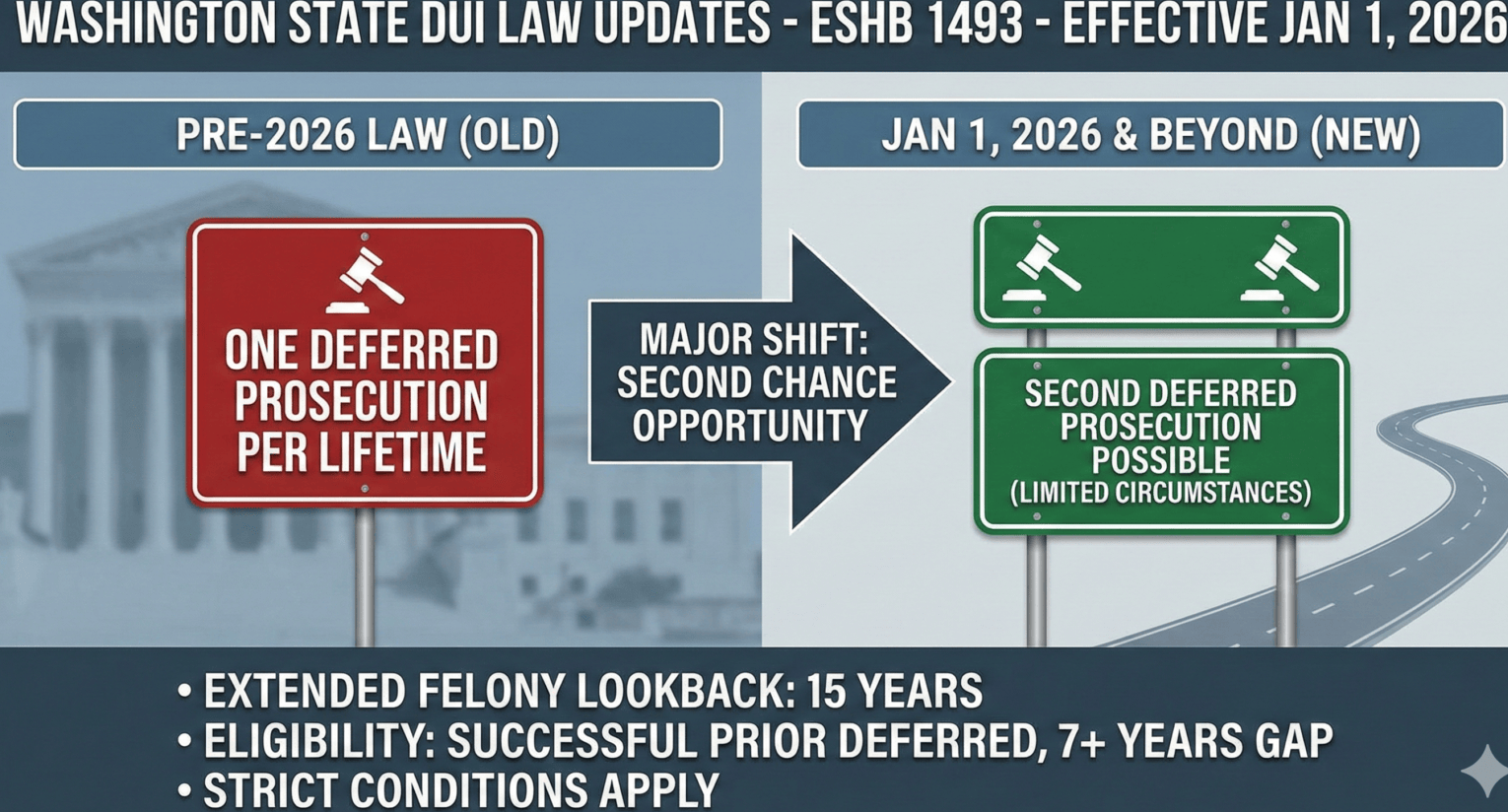
Starting January 1, 2026, Washington’s DUI laws change in several important ways under Engrossed Substitute House Bill 1493 (ESHB 1493). One of the biggest shifts is that some drivers will now be eligible for a second deferred prosecution in DUI and physical control cases, something that was not allowed under prior law.
What Is Deferred Prosecution?
Deferred prosecution is a treatment-based alternative to a DUI conviction in Washington. Instead of going to trial and risking a conviction, a person can petition the court to enter a intensive, usually two-year treatment program, comply with strict conditions, and, if they successfully complete the program and follow all court orders, have the DUI charge ultimately dismissed.
This option is aimed at people whose criminal conduct is closely tied to a substance use disorder or mental health condition. It is not a “get out of jail free” card; it requires long-term treatment, court monitoring, abstinence, and financial and lifestyle commitments.
What Changes on January 1, 2026?
Under current law, a person generally gets only one deferred prosecution in their lifetime for DUI-related offenses. ESHB 1493 changes this rule by allowing a second deferred prosecution in limited circumstances, while also making other major adjustments to DUI penalties and procedures.
Key changes taking effect on January 1, 2026, include:
- Certain drivers charged with a misdemeanor DUI or physical control will be able to petition for a second deferred prosecution, if they meet specific criteria.
- The “lookback” period that can turn a DUI into a felony is extended from 10 years to 15 years, meaning older prior offenses can now more easily elevate a new DUI to a felony.
- The law also adds new sentencing options and procedural changes for impaired driving cases, including a structured treatment and sentencing program for some felony DUIs.
Who Can Get a Second Deferred Prosecution?
The new law does not open the door for everyone to get multiple deferred prosecutions. Instead, it creates a narrow pathway for a second chance for people who have demonstrated long-term success and have stayed out of serious trouble between cases.
In general terms, a person may seek a second deferred prosecution starting in 2026 if:
- They are currently facing a misdemeanor DUI or physical control charge.
- They successfully completed a prior deferred prosecution for a DUI-related offense.
- That prior deferred prosecution was completed at least seven years before the new case, and the law requires that the earlier deferred prosecution was not within the recent 7-year window.
- They do not have certain disqualifying priors, including vehicular homicide, vehicular assault, or felony DUI convictions.
Importantly, if someone could have taken deferred prosecution on an earlier DUI but chose not to and instead took a conviction, they do not automatically gain unlimited new opportunities under this law. The statute is designed to give a second treatment-based opportunity to people who previously completed deferred prosecution and stayed law-abiding for a significant period, not to allow repeated use of the program in quick succession.
What Stays the Same About Deferred Prosecution?
Even with the 2026 changes, many core features of deferred prosecution remain the same:
- Formal petition and evaluation: A person must file a formal petition in a court of limited jurisdiction under chapter 10.05 RCW and undergo a professional assessment (typically for substance use or mental health).
- Treatment and conditions: The court can order a two-year treatment plan, abstinence from alcohol and non-prescribed drugs, compliance with treatment recommendations, ignition interlock in some cases, and other monitoring conditions.
- Dismissal only after completion: The DUI charge is not dismissed immediately. Dismissal typically occurs years later, after proof of successful treatment completion and ongoing compliance with conditions.
- Serious consequences if you fail: If someone fails the program or violates the court’s conditions, the court can remove them from deferred prosecution, enter a conviction, and impose sentence as if they had been found guilty at trial.
Why Did the Legislature Add a Second Chance?
Lawmakers recognized that recovery from substance use disorder is often not linear and that some people who genuinely benefit from treatment may relapse years later. By allowing a carefully limited second deferred prosecution, the law aims to reduce repeat impaired driving, improve long-term public safety, and encourage engagement with treatment rather than purely punitive outcomes.
At the same time, the legislature balanced this with stricter felony treatment for repeat offenders by extending the felony lookback period to 15 years. In other words, the system offers more treatment opportunities in some situations, but also tougher long-term consequences for people who repeatedly drive impaired.
How These Changes Might Affect Your Case
If you are charged with DUI or physical control and you previously completed a deferred prosecution, your options in 2026 and beyond may be very different from what they were under the old law. The availability of a second deferred prosecution will depend on the specific dates of your prior case, your prior record, and whether you satisfy the new statutory criteria in chapter 10.05 RCW and the DUI statutes.
Because these rules are technical and the stakes are high—including potential felony exposure under the extended 15-year lookback—it is crucial to get case-specific legal advice rather than relying on general information.