
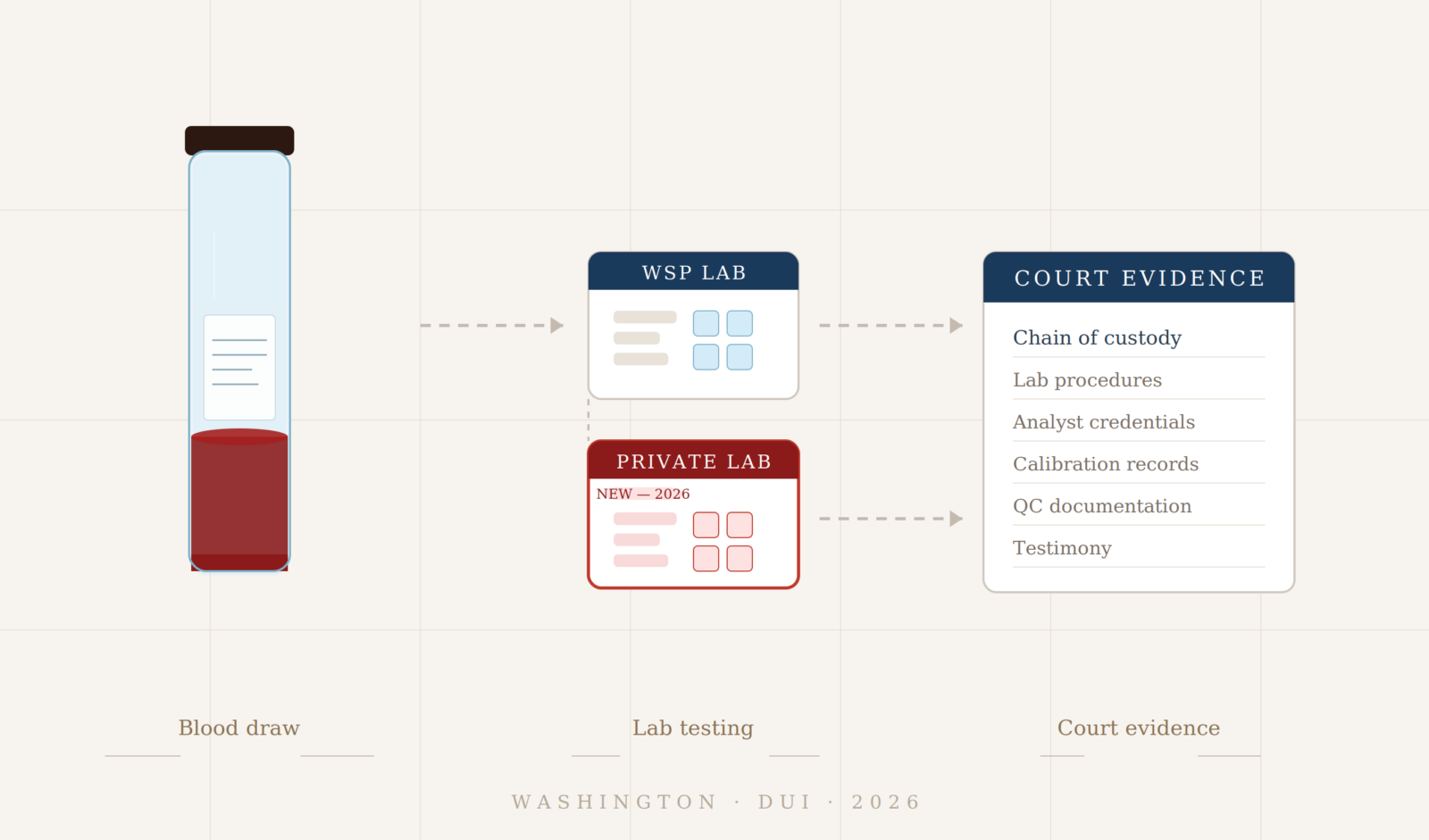
In April 2026, Washington quietly passed a law that changes how DUI blood samples get tested. It sounds procedural. But if you’re facing a DUI charge, it’s actually worth understanding — because it opens up new angles that didn’t exist before.
Here’s the background, and more importantly, what it means for your case.
The backlog was a serious problem
For years, Washington’s DUI blood testing ran almost entirely through the Washington State Patrol lab. And the system couldn’t keep up.
At its worst, over 16,000 blood samples were sitting in a queue waiting to be tested. Results routinely took more than a year. That’s not just an inconvenience — it creates real legal problems. Cases get filed late. Evidence becomes harder to scrutinize as time passes. And people are left in legal limbo, not knowing what they’re actually being charged with or what the evidence against them even says.
Some of those delays raised legitimate due process concerns. Faster testing is genuinely better. But faster isn’t the same as simpler.
What the new law actually does
Washington now allows accredited private laboratories to process DUI blood samples. The WSP isn’t going away — they still oversee forensic toxicology, maintain the breath testing program, and keep records that often end up being central evidence in court. But private labs can now be part of the chain.
That’s a meaningful shift.
Why this matters in court
Most DUI cases come down to one of two things: a breath test or a blood test.
Breath tests use the Draeger Alcotest 9510, which is the standard machine across Washington. The State still has to show the machine was properly maintained, the required checks were done, and the officer followed the right procedures. If any of that breaks down, the result can be challenged.
Blood tests are more common in serious cases — accidents, very high BAC readings, or suspected drug impairment. Until now, most blood testing went through the WSP lab, and attorneys knew exactly what records to ask for and what to look for.
Private labs change that dynamic. Here’s how.\
The new legal questions this creates
Chain of custody gets more complicated. A blood sample may pass through several hands before testing is complete. Every single handoff has to be documented. If the documentation has gaps, that raises real questions about whether the sample was handled properly — or whether it was even the right sample.
Labs don’t all work the same way. Even accredited labs can use different equipment, different methods, different protocols. In close cases, those differences can matter more than you’d expect.
There are more records to chase down. With WSP, attorneys knew the paper trail. With a private lab, you’re now potentially looking at calibration records, analyst credentials, quality control logs, and internal testing procedures that have never been part of DUI litigation in Washington before. That’s more to review — and sometimes more places where something doesn’t add up.
Analyst testimony can get complicated. If a private lab ran the test, the analyst who did the work may be called to testify. That can affect how the State presents its case, and it creates opportunities that didn’t exist when everything ran through a single state agency.
The bottom line
Washington’s courts are still working through how this law applies in practice. We’re still early. What’s clear is that blood test cases are now more complex — more steps, more people involved, more records to examine.
That’s not necessarily a bad thing if you’re defending a charge. But it does mean the details matter more than ever.
If your case involves a blood test, this is an area that deserves a hard look. How the sample was collected, where it went, which lab tested it, what procedures they followed, and whether the documentation holds up — all of it is fair game.
If you have questions about a DUI charge, I’m happy to talk through the specifics of your situation.