
Washington DUI Deferred Prosecution: How It Works
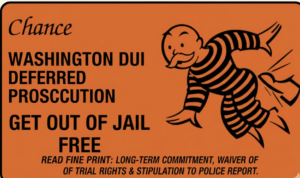
Deferred prosecution is one of the few ways a DUI case in Washington can ultimately be dismissed. It is not a shortcut and it is not the right option for everyone. Deferred prosecution is a court-supervised, treatment-based program that requires a long-term commitment, strict compliance, and giving up important trial rights.
Before you decide whether this program makes sense in your case, you should understand exactly how it works, what you must agree to, and the risks if you do not complete the program.
What Is Deferred Prosecution in a Washington DUI Case?
Deferred prosecution is authorized by RCW Chapter 10.05. In a DUI or physical control case, the court may pause the criminal prosecution while you complete a treatment program. If you successfully complete all requirements, the court dismisses the charge.
Deferred prosecution is based on the idea that the DUI conduct was caused by a condition that requires treatment and that, without treatment, the likelihood of reoffending is high. Because of that, this option is treatment focused rather than punishment focused.
The Main Benefit
The primary benefit of deferred prosecution is that it provides a path to dismissal of the DUI charge. Unlike a plea bargain or reduced charge, successful completion results in the case being dismissed rather than ending in a conviction.
For many people, avoiding a DUI conviction and mandatory minimum jail time are the biggest reasons they consider the program.
The Most Important Downsides and Risks
You Have the DUI Punishment Hanging Over Your Head
To enter into deferred prosecution, you must sign a petition that includes waivers of important constitutional rights to trial and to challenge the evidence. You also agree that the written police report is admissible and sufficient for the court to enter a guilty finding if you are revoked from the program (RCW 10.05.020).
If you do not successfully complete the program for whatever reason, you will face a near-automatic conviction of the underlying DUI charge.
It Is a Long-Term Commitment
Deferred prosecution is not quick. The treatment program lasts two years (RCW 10.05.150). The court can dismiss the charge three years after you finish treatment and follow the court’s conditions, but no sooner than five years after the deferred prosecution is granted (RCW 10.05.120). Many people underestimate how demanding long-term compliance can be, especially when life circumstances change.
Treatment Requirements Are Strict
For DUI cases, the two-year program includes (RCW 10.05.150):
- Total abstinence from alcohol and non-prescribed drugs
- Intensive outpatient or inpatient treatment, depending on your diagnosis
- At least two support group meetings a week during treatment
- Random urine or breath tests
- At least weekly counseling for six months after the intensive phase, then at least monthly contact for the rest of the two years
Courts expect full compliance. Missed appointments, positive tests, or failure to follow treatment recommendations can place your deferred prosecution at risk.
Ignition Interlock Requirement
When the court grants a deferred prosecution based on substance use, the court must order an ignition interlock, for at least the same periods the law requires after a DUI (RCW 10.05.140). You also cannot drive without a valid license and proof of insurance. Learn more about the ignition interlock. Talk to your attorney about this.
Your License and the Probationary License
A deferred prosecution is not a conviction for driver’s license purposes, but it does go on your driving record. After it is granted, the Department of Licensing will tell you to apply for a probationary license within 45 days, and your license will be on probationary status for five years (RCW 10.05.060; RCW 46.20.355). Each probationary license costs $50 on top of regular licensing fees.
The deferred prosecution does not take care of the separate license suspension from your arrest. That is handled at a DOL hearing, which has its own short deadline.
It Counts as a Prior Offense
A DUI deferred prosecution counts as a “prior offense” if you are charged with DUI again (RCW 46.61.5055(14)). That can mean higher mandatory penalties on a future case.
Who Qualifies for Deferred Prosecution?
Eligibility depends on the charge, your history, and whether the court can make the findings required by law. Deferred prosecution is available for misdemeanor and gross misdemeanor charges, which includes most DUI and physical control cases.
The condition behind your case can be a substance use disorder or a mental health disorder (RCW 10.05.020). A deferred prosecution for a mental health disorder that occurs together with substance use includes mental health services as part of treatment (RCW 10.05.150).
As of January 1, 2026, Washington law allows a second deferred prosecution in some DUI cases (RCW 10.05.010):
- If you used a deferred prosecution for your first DUI or physical control charge, you can ask for a second one for your next DUI, as long as you have no other prior offenses. Your first deferred prosecution does not count against you for this purpose.
- If you did not use a deferred prosecution on your first DUI, you can still ask for one later, but only once.
Read more about the 2026 second deferred prosecution law.
Timing matters too. The petition must be filed at least seven days before your trial date, unless the court finds good cause for the delay (RCW 10.05.010).
Because deferred prosecution is discretionary, qualifying on paper does not guarantee approval.
What You Must Show the Court
Your petition must support findings that:
- The wrongful conduct was caused by a condition that requires treatment
- Without treatment, the probability of repeating the conduct is great
You also must include an assessment from a state-approved treatment agency (RCW 10.05.020). The court will not accept a petition from someone who sincerely believes they are innocent, or who believes they do not have the condition.
In practical terms, deferred prosecution is designed for people who are prepared to engage in treatment and take the program seriously.
What Does It Cost?
You agree to pay for your assessment and treatment if you are able to (RCW 10.05.020). The court can also order you to pay court costs and restitution (RCW 10.05.140). On top of that, plan for interlock, monitoring, and probationary license costs. Ask your treatment provider and attorney for estimates in your situation.
What the Process Usually Looks Like
Although procedures vary by court, deferred prosecution cases often follow this general path:
- Careful review of the police report, driving history, and prior record to decide whether deferred prosecution is a smart option
- Completion of a substance use or mental health assessment and preparation of the required petition and waivers
- Filing the petition and scheduling a court hearing
- Enrollment in treatment and compliance with all court-ordered conditions if deferred prosecution is granted
- Long-term monitoring followed by dismissal review after successful completion
What Happens If You Fail the Program?
This is the part many people underestimate.
If you break a treatment or interlock condition, the provider must report it to the court, and the court holds a hearing where you can present your side (RCW 10.05.090). If deferred prosecution is revoked, the court may enter a guilty finding based on the police report and the stipulation you signed at the beginning of the case. There is typically no trial on the underlying facts at that point.
If you are unsure whether you can realistically comply with the program, that concern should be addressed before you choose to enter into the program.
Is Deferred Prosecution Right for You?
Deferred prosecution can be a good option if:
- You are motivated to participate in treatment
- You can commit to long-term compliance
- Avoiding a DUI conviction is a top priority
It may be a poor fit if:
- You are not prepared for abstinence and monitoring
- Your work or travel schedule makes compliance unrealistic
- You want the fastest possible resolution rather than a long-term program
How I Help
My role is to help you make an informed decision and avoid preventable mistakes. That includes:
- Evaluating whether deferred prosecution is available and advisable in your case
- Explaining the waivers and stipulations in plain English before you sign them
- Guiding you through assessments, paperwork, and court procedures, starting at your DUI arraignment
- Discussing alternatives when deferred prosecution is not the best option, such as a reduction to reckless driving or negligent driving
Talk to a Lawyer Before You Decide
Deferred prosecution can be a powerful tool, but it carries real risks. Before you commit to years of treatment and sign away trial rights, you should understand exactly what you are agreeing to.
If you are facing a DUI in Washington and want to discuss deferred prosecution, contact my office for a free consultation.
Kris Carrasco Attorney at Law
1014 Franklin Street, Vancouver, WA 98660
Phone: (360) 975-4673
Call or contact us online to schedule your free consultation.